
Anchor Windlass

Anchor Windlass is a critical marine deck machinery system designed for the safe and controlled handling of anchors and anchor chains during mooring and anchoring operations. It is widely used on commercial vessels, offshore units, workboats, tugboats, ferries, and yachts, ensuring reliable deployment and retrieval of anchors under demanding sea conditions.

1.1 Vertical Windlass
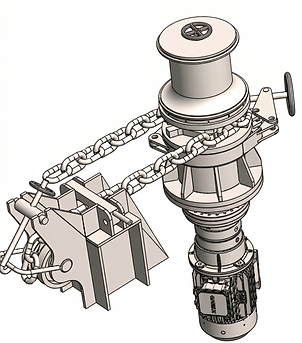
The main difference of vertical type is that the profile deck is very compact as the motor and the gearbox are under the deck. With the help of this advantage, they are suitable for every kind of vessel and preffered more than horizontal ones in recent years. Vertical windlasses look more esthetic and offer more security for anchoring by making 180° chain wrap around the gypsy. If there are two anchors, positioning of the windlass on deck is much more flexible than horizontal ones. Also two independent vertical windlasses offer higher security comparing a horizontal windlass with 2 gypsy on 1 shaft. Since most of the mechanical components are under the deck, maintenance operations are slightly difficult than the horizontal windlasses.
1.2 Horizontal Windlass
This type of windlasses are entirely installed above deck. Due to this reason, maintenance and installation operations are simpler than vertical ones. Horizontal windlasses provide 90°-120° wrap of chain around the gypsy Horizontal Windlass is a deck-mounted anchoring machine with a horizontally oriented shaft, used to deploy and recover anchor chain or wire rope. It is typically driven by electric or hydraulic motors and designed to withstand high mooring loads. Horizontal windlasses are commonly used on small to medium-sized vessels due to their compact layout and ease of installation.

1. 3 Chain Stooper
A Chain Stopper is a safety device installed on the ship’s deck to secure the anchor chain and transfer the anchor load from the windlass to the ship’s structure. It prevents continuous loading on the windlass after anchoring.
Working Principle:
After the anchor is deployed, the anchor chain is seated into the locking mechanism of the chain stopper. The tensile load of the chain is carried by the stopper body, allowing the windlass to be disengaged and used only for hoisting and lowering operations.
Main Features:
-
Load Holding: Safely supports the static load of the anchor chain
-
Safety: Prevents uncontrolled chain release
-
Types:
-
Pelican hook chain stopper
-
Devil’s claw chain stopper
-
Lever or turnbuckle type
-
Material: High-strength forged or cast steel
-
Standards: Compliant with IACS, ABS, DNV, LR, BV, RINA
-
Applications: Commercial vessels, offshore units, tugboats, yachts

1.4 Mooring Capstan
A Mooring Capstan is a vertical-axis deck machine used for handling mooring ropes or wires during berthing and unberthing operations. It provides controlled pulling force by rotating a capstan head around which the mooring line is wrapped. Mooring capstans are typically driven by electric or hydraulic motors and are designed for continuous-duty operation.
Key Features
Vertical rotating capstan head
Electric or hydraulic drive
Suitable for rope and wire handling
Smooth and controlled line tension
Designed according to class society standards (ABS, DNV, LR, BV, etc.)